
Type a question into Google today, and there’s a good chance you won’t click a single blue link to get your answer. An AI-generated summary powered by systems like Google’s AI Overviews, ChatGPT, Perplexity, or Claude will hand you a synthesized response, complete with sources it trusts enough to cite. For the businesses behind those sources, that citation is the new #1 ranking. For everyone else, it’s invisibility.
This is not a distant, hypothetical shift. It’s already reshaping how traffic flows across the web, and it’s forcing marketers to rethink a discipline that felt settled just a few years ago. SEO isn’t dying, but the SEO that only optimizes for ten blue links is. What’s replacing it is something broader: a strategy built for both traditional search engines and the AI models now standing between your content and your customer.
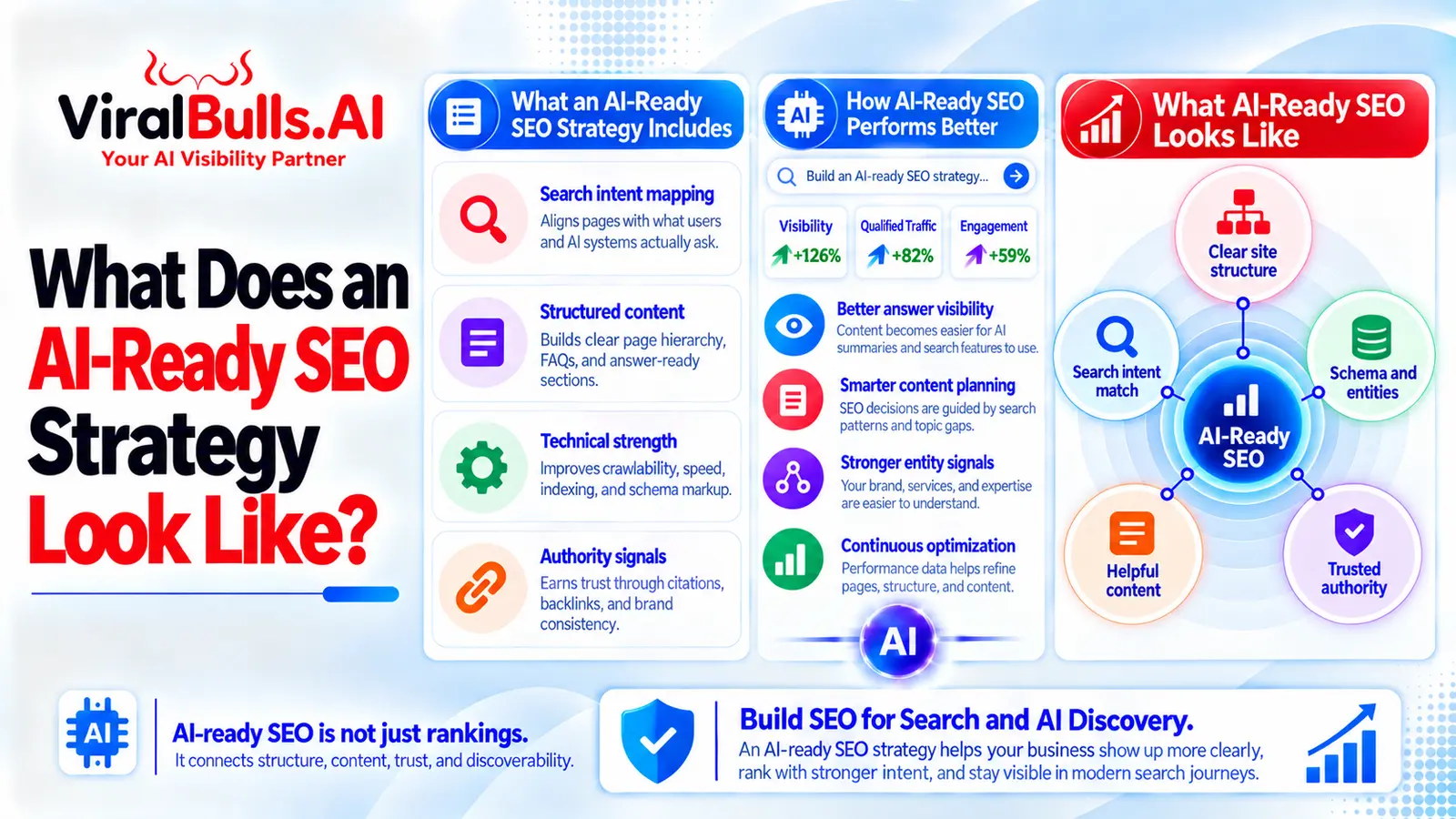
So what does an AI-ready SEO strategy actually look like in practice? Let’s break it down.
Why Traditional SEO Alone No Longer Cuts It
For two decades, SEO success was measured in rankings, click-through rates, and organic sessions. That scoreboard still matters, but it’s no longer the whole game. Generative Engine Optimization (GEO), Answer Engine Optimization (AEO), and AI-search visibility have joined the mix, because increasingly, the “user” reading your content first is a language model, not a person.
AI systems crawl, parse, and synthesize information from many sources at once, then decide which of those sources are authoritative enough to cite or pull from. If your content isn’t structured, verifiable, and genuinely useful in ways machines can parse, you simply won’t make the cut — no matter how well you’d rank in classic search.
The takeaway: AI readiness isn’t a replacement for SEO fundamentals. It’s an additional layer built on top of them.
The Core Pillars of an AI-Ready SEO Strategy
1. Content Built for Extraction, Not Just Reading
AI models favor content that answers questions clearly and directly. That means restructuring how you write: lead with the answer, then support it with context, data, and nuance. Long, meandering introductions that bury the point may read fine to a human skimmer, but they’re harder for an AI system to extract cleanly.
- Answer the core question in the first 1-2 sentences of a section.
- Use descriptive H2s and H3s that mirror real search queries.
- Break down complex ideas with lists, tables, and short paragraphs.
- Define key terms plainly — AI models reward clarity over cleverness.
2. E-E-A-T Signals That Actually Hold Up
Experience, Expertise, Authoritativeness, and Trustworthiness aren’t just a Google guideline anymore — they’re the filter AI systems use to decide whose content is safe to cite. Author bios, credentials, original data, case studies, and transparent sourcing all strengthen these signals, while generic, unattributed content tends to get filtered out. If your pages don’t clearly show who wrote them and why they’re qualified, that’s one of the fastest fixes available to you.
3. Structured Data and Technical Clarity
Schema markup, clean HTML hierarchy, and fast, crawlable pages matter more than ever. Structured data acts like a translation layer, telling both search engines and AI crawlers exactly what a piece of content is about, who created it, and how it’s organized. FAQ schema, article schema, and organization schema are especially valuable, since they map neatly onto the question-and-answer format AI systems prefer.
- Implement FAQ, Article, and Organization schema where relevant.
- Keep site architecture flat and logical so crawlers can find content easily.
- Ensure fast load times and mobile responsiveness — technical debt hurts AI visibility too.
4. Topical Authority Over One-Off Keywords
AI systems weigh how comprehensively a domain covers a subject, not just how a single page performs. A handful of shallow posts about “SEO tips” is far less likely to be cited than a genuinely deep content cluster covering the topic from every reasonable angle. A funnel-based content strategy builds this: broad top-of-funnel guides establish breadth, mid-funnel comparisons demonstrate depth, and bottom-funnel service pages convert that authority into leads.
5. Brand Mentions and Digital PR
Large language models are trained and grounded partly on how frequently and positively a brand is mentioned across the web — in news coverage, forums, and industry publications. This makes digital PR a direct input into AI visibility, not just a branding nicety. Mentions on reputable third-party sites, active community presence, and consistent business information all shape how confidently an AI system references your brand.
6. Conversational and Intent-Rich Keyword Research
People don’t type into AI chat interfaces the way they type into a search bar. Queries are longer and more conversational: “What’s the best AI-ready SEO strategy for a small salon competing with bigger chains?” instead of “SEO strategy salon.” An AI-ready keyword strategy targets these natural-language questions and long-tail phrases, not just isolated short-tail terms.
Putting It All Together: A Funnel for the AI Era
The most effective AI-ready strategies still follow a funnel, but each stage now does double duty — serving human readers and AI systems at once.
Top of funnel: Educational, question-answering content that builds topical authority and gets picked up by AI Overviews and chat-based assistants for broad, informational queries.
Middle of funnel: Comparison guides, case studies, and how-to content that demonstrate expertise and help AI systems (and humans) evaluate you against alternatives.
Bottom of funnel: Clear, structured service and product pages with strong trust signals that convert AI-driven and organic visibility into actual leads and revenue.
This layered approach ensures you’re not just chasing visibility for its own sake — every piece of content has a job to do in moving a reader (or an AI’s recommendation) closer to a decision.
Getting Started: Where to Focus First
You don’t need to overhaul everything overnight. Start with an audit of your highest-traffic pages, and ask three questions of each one:
- Does it clearly and directly answer the question a reader (or an AI) came for?
- Does it show real expertise — original insight, data, or experience — rather than generic advice?
- Is it technically structured so a crawler or AI model can easily parse and trust it?
Fix the gaps on your best-performing content first, then extend the same standards to everything new you publish. Over time, this compounds into the trustworthy, well-structured presence that both search engines and AI systems reward.
The Bottom Line
An AI-ready SEO strategy isn’t a separate discipline from SEO — it’s SEO grown up for a world where search results are increasingly synthesized rather than simply listed. It rewards the same things good SEO always has: genuine expertise, clarity, usefulness, and trust, expressed in ways machines can recognize as clearly as humans can.
The brands that adapt now — restructuring content for extraction, strengthening trust signals, and building topical depth — will be the ones AI systems recommend by default. The brands that wait risk becoming invisible in exactly the moment discovery matters most. You don’t need all the answers today. You just need to start building toward being the answer.
Frequently Asked Questions
Not exactly. Traditional SEO focuses on ranking in search engine results pages. AI-ready SEO builds on those same fundamentals but adds a layer optimized for how AI models and answer engines extract, evaluate, and cite content. Think of it as SEO plus visibility inside AI-generated answers.
It’s unlikely they’ll replace it entirely, but they are already reducing click-through rates for many informational queries. That’s exactly why brands need a dual strategy: rank well in traditional results while also becoming a source AI systems are confident citing.
Timelines vary by industry and competition, but most businesses start seeing meaningful shifts in visibility within three to six months of consistently improving content structure, E-E-A-T signals, and technical SEO — similar to traditional SEO timelines, though AI citation patterns can sometimes shift faster than rankings.
No. Start with an audit of your highest-value pages and prioritize fixes there. Most sites don’t need a full rewrite, they need clearer structure, stronger sourcing, and better answers to the specific questions their audience is asking.
Restructure your most important pages so the core answer appears clearly near the top, supported by credible expertise and clean formatting. It’s a fast, low-cost change that benefits both human readers and AI systems immediately.