
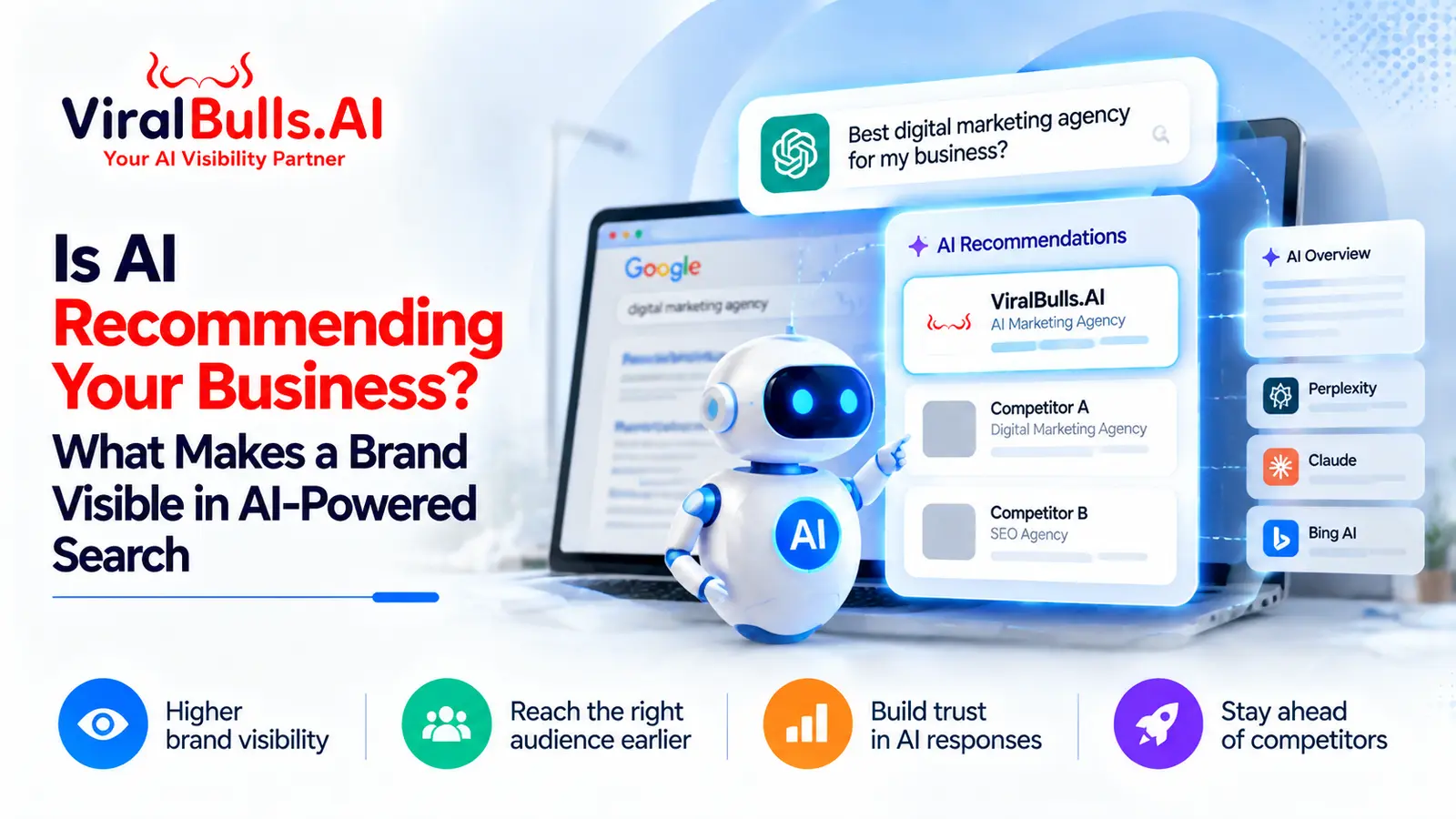
A potential customer asks an AI assistant for the best service provider in your category. The answer lists three businesses, explains what each one is known for, and suggests which option may suit different needs.
Your company does not appear.
That can happen even when your website ranks for important Google searches. Traditional search visibility and inclusion in AI-generated answers are connected, but they are not identical outcomes.
Search engines first need to access and understand your website. AI-powered search experiences then need enough reliable context to summarize, compare, or recommend the brand with confidence.
The practical question is no longer only, “Can customers find us?” It is also, “Can an AI system understand what we do, trust the evidence, and explain why we are relevant?”
What It Means for AI to Recommend a Business
An AI recommendation does not always look like a formal endorsement. It may appear as a shortlist, comparison, cited source, suggested provider, product option, or explanation of which businesses serve a particular need.
These answers may draw on indexed content, trusted sources, reviews, structured data, and other available signals.
AI SEO services should focus on making a brand understandable and credible rather than promising a fixed citation position.
Google Visibility Still Matters
Google has stated that its generative AI search features use core Search ranking and quality systems. Its guidance continues to emphasize crawlability, useful content, technical accessibility, and people-first information.
This means businesses should not abandon SEO in pursuit of a separate AI trick. A site that is blocked, thin, confusing, duplicated, or difficult to index will not become more visible merely by adding AI-focused terminology.
Generative Engine Optimization works best as an extension of strong SEO. It asks how content can be structured, evidenced, and connected so that an answer engine can use it confidently.
1. Clear Entity Information
AI systems need to identify the business as a consistent entity.
Use the same company name, service descriptions, locations, leadership information, contact details, and social profiles across the website and credible external sources.
An informative About page should explain who the company is, what it does, who it serves, and what experience supports its claims. Team and author pages can also help clarify where expertise comes from.
Conflicting information creates uncertainty. If one profile describes the business as a software company, another as a marketing consultancy, and the website does not clearly connect the services, the brand becomes harder to summarize.
2. Strong Topical Coverage
One service page rarely provides enough context for broad recommendations.
A brand becomes easier to understand when it consistently covers the questions customers ask before buying. That includes definitions, comparisons, implementation guidance, risks, costs, use cases, alternatives, and evidence.
For example, an AI marketing company should not publish only a page titled “AI Marketing Services.” It should build connected content around AI SEO, automation, AI video, websites, content operations, campaign management, and measurement.
This creates a coherent topic footprint instead of a collection of unrelated posts.
3. Original Evidence
Generic statements are easy to reproduce and difficult to attribute.
Brands become more valuable as sources when they publish information that adds something distinctive: case studies, first party data, expert frameworks, documented processes, product specifications, before and after metrics, or lessons from implementation.
Evidence should be specific enough to evaluate. Replace claims such as “we deliver exceptional results” with an explanation of the situation, action, measurement period, and outcome.
AI powered systems may still choose other sources, but original evidence gives them a stronger reason to use or cite yours.
4. Helpful Page Structure
Clear structure helps both people and machines process information.
Use descriptive headings, direct answers, short explanatory paragraphs, meaningful tables, and FAQs where they genuinely serve the reader. Internal links should connect related pages so the broader topic is easy to navigate.
Structured data can provide explicit information about organizations, articles, products, events, and other entities. Google advises that markup should match visible page content and follow its technical and quality guidelines.
Schema is a clarification layer, not a substitute for a useful page.
5. Credible External Signals
Your website is not the only place where the brand is evaluated.
Relevant media coverage, industry directories, reviews, partner pages, professional profiles, conference participation, and genuine citations can reinforce what the website claims.
The quality and relevance of these signals matter more than volume. Hundreds of low quality placements created only for links or mentions may add noise rather than trust.
Generative Engine Optimization should include digital authority building, but it should not become artificial mention manufacturing.
6. Current and Accurate Information
AI answers are less useful when the underlying sources are outdated.
Review important service pages, statistics, pricing conditions, leadership information, case studies, and product details regularly. Show meaningful update dates when content has actually been reviewed or changed.
Accuracy is especially important for regulated, technical, financial, or health related topics. Claims should be supported and reviewed by people with the relevant knowledge.
7. A Brand Worth Recommending
Optimization cannot compensate for a weak offer.
AI may understand a business perfectly and still have little reason to recommend it if the website provides no clear differentiation, proof, customer fit, or credible reputation.
Brands should define who they serve best, which problems they solve, and why their approach is meaningfully different. Clear positioning makes recommendations easier because the system can connect the business to a specific need.
Brand Visibility Checklist
Use this checklist as a practical starting point for an AI search review.
| Area | Question to Ask |
|---|---|
| Technical access | Can search systems crawl and index every important page? |
| Entity clarity | Is the company described consistently across credible sources? |
| Topic depth | Does the site answer the full set of buyer questions? |
| Evidence | Are claims supported by cases, data, or documented expertise? |
| Structure | Are headings, links, and structured data clear and accurate? |
| Authority | Do relevant external sources confirm the brand’s credibility? |
| Positioning | Is it obvious who the business serves and why it is different? |
How ViralBulls Improves AI Search Visibility
ViralBulls combines technical SEO, content strategy, entity optimization, authority development, and Generative Engine Optimization.
Our AI SEO services begin with an audit of whether search systems can access, understand, and trust the brand. We review site structure, service coverage, content gaps, brand consistency, schema, proof, external signals, and conversion journeys.
We then prioritize improvements based on business relevance. The objective is not to create content for every possible question. It is to build a credible knowledge footprint around the services and customers that matter most.
No responsible agency can guarantee that a specific AI system will recommend a brand. We can build the technical, content, and authority foundations that improve the likelihood of meaningful visibility.
Final Thought: Be the Brand an Answer Can Explain
AI powered search is changing discovery from a list of links into a layer of summaries, comparisons, and recommendations.
Businesses still need Google visibility, but rankings alone do not communicate the full value of a brand.
To become more recommendable, the business must be technically accessible, clearly positioned, topically complete, supported by evidence, and consistently represented across the web.
The strongest strategy is not to chase AI mentions. It is to become a source and a brand that deserves to be included.
Frequently Asked Questions
No. Strong Google visibility is valuable, but AI generated answers may use additional context, sources, and retrieval methods. Rankings do not guarantee inclusion in a recommendation.
They combine established SEO practices with work that improves entity clarity, topic coverage, structured content, authority, and visibility across AI powered search experiences.
Generative Engine Optimization is the practice of improving content and brand signals so that generative search and answer systems can understand and potentially surface them.
No. It can clarify page meaning, but it must match visible content and does not replace quality, authority, or relevance.
Technical improvements may be completed quickly, while authority, topic depth, and external recognition generally require consistent work over time.
No responsible agency can guarantee inclusion in a particular AI answer. ViralBulls focuses on improving the foundations that make a brand easier to understand, trust, and surface.