
Picture this: someone asks ChatGPT, Perplexity, or Google’s AI Overviews a question your website could easily answer. Your content exists. Your expertise is real. But the AI never mentions you because it never truly “understood” your page in the first place.
This isn’t a hypothetical anymore. Millions of people now get their answers directly from AI assistants instead of clicking through ten blue links. These tools don’t crawl the web the way traditional search engines do; they parse, interpret, and synthesize. If your site isn’t built for that kind of reading, you’re invisible to an entire generation of searchers, no matter how good your content is.
The good news? Making your website AI-friendly isn’t some mysterious black art reserved for tech giants. It’s a set of practical, learnable habits, and once you understand them, you can start applying them today. Let’s break down exactly how AI search engines “read” your site, and what you can do to make sure they read it correctly.
Why AI Search Engines “Read” Websites Differently
Traditional search engines like Google built their reputation on matching keywords and ranking pages by authority signals such as backlinks. AI search engines and large language models (LLMs) work differently. Instead of just indexing keywords, they try to extract meaning — facts, relationships, context, and structure — so they can generate a coherent answer or summary.
That means an AI crawler cares less about how many times you repeated “best running shoes” and more about whether your page clearly explains what running shoes are good for which foot type, price range, or terrain. It’s looking for clarity, structure, and verifiable facts it can lift and reuse confidently.
In short: AI search rewards websites that are easy to parse, not just easy to rank. Here’s how to build one.
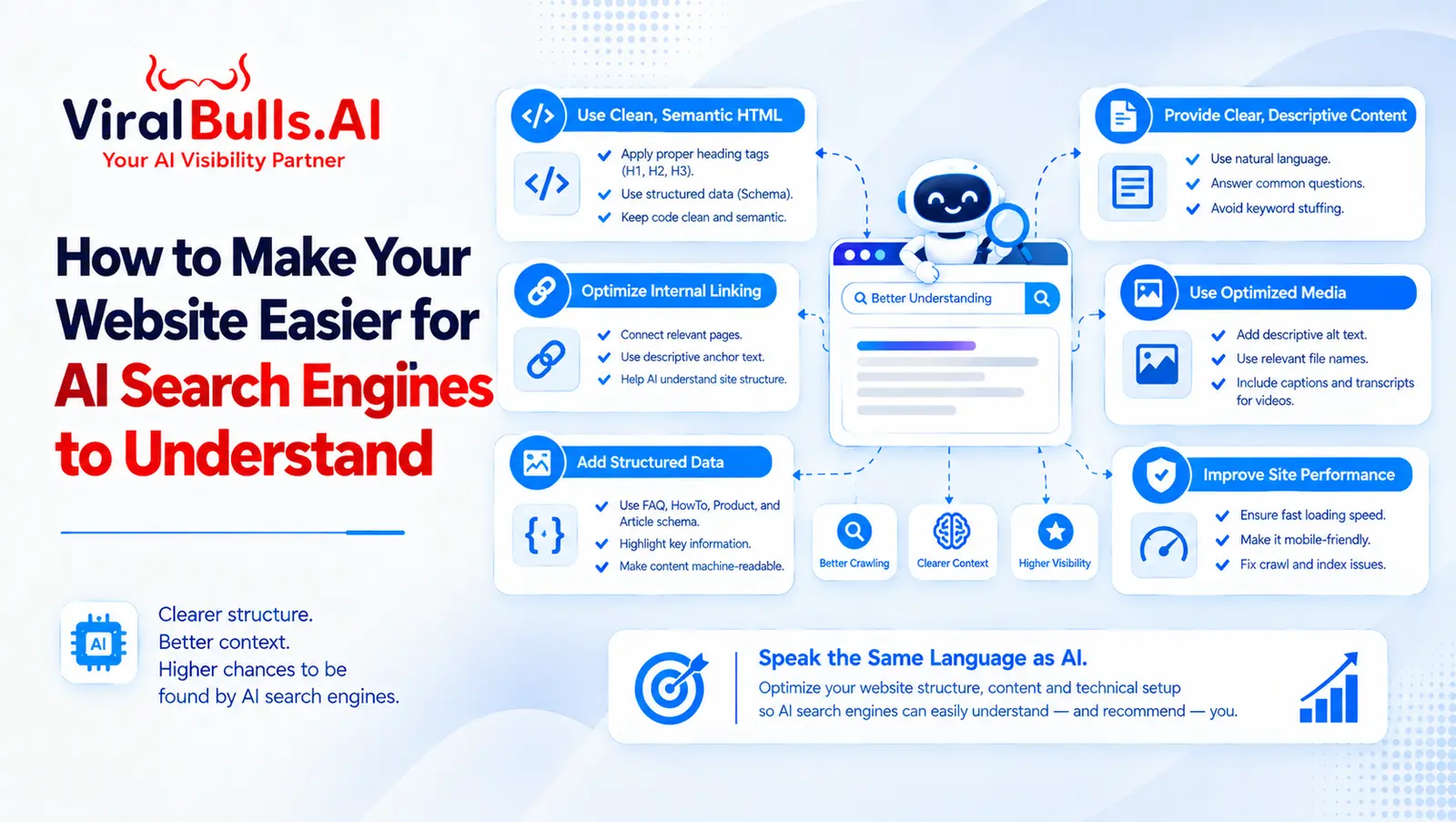
1. Structure Your Content So Machines Can Follow It
AI models parse HTML structure to understand hierarchy and relationships between ideas. A wall of unstructured text — even if beautifully written — is much harder for a model to extract clean facts from.
- Use proper heading tags (H1, H2, H3) in a logical order, not just for visual styling.
- Break complex topics into short, focused sections with descriptive subheadings.
- Use bullet points and numbered lists for steps, comparisons, or specifications.
- Keep paragraphs short — 2 to 4 sentences works best for both humans and machines.
Think of your page structure as a table of contents an AI can skim in seconds. The clearer the map, the more accurately your content gets represented.
2. Write in Clear, Declarative Language
AI systems favor direct statements over vague marketing fluff. Sentences like “Our innovative solution redefines the industry” give a model nothing concrete to extract. Compare that to: “This tool reduces onboarding time from three weeks to three days.”
Aim for specificity wherever possible — numbers, dates, comparisons, and named entities. The more concrete your claims, the more likely an AI system is to quote or cite you accurately, rather than skip your page entirely because it can’t confirm what you’re actually saying.
3. Use Structured Data (Schema Markup)
Schema markup is one of the most underused tools for AI visibility. It’s a standardized vocabulary (from Schema.org) that tags your content with explicit meaning — this is a product, this is a review, this is a step in a recipe, this is a person’s job title.
- Add FAQ schema to any question-and-answer content.
- Use Article or BlogPosting schema for blog content, including author and publish date.
- Mark up products, reviews, and pricing with Product and Review schema.
- Use Organization schema to clarify who you are and what you do.
Structured data removes ambiguity. Instead of an AI guessing whether a number on your page is a price, a rating, or a phone number, schema tells it directly — dramatically increasing the odds your content gets used correctly in AI-generated answers.
4. Make Your Content Genuinely Answer Questions
AI search engines are, at their core, answer engines. They reward pages that directly and completely resolve a searcher’s question, rather than pages that dance around a topic to pad word count.
A useful exercise: for every page on your site, ask “What specific question is this meant to answer?” If you can’t answer that in one sentence, the page likely lacks the focus that AI systems are looking for. Consider adding a concise, direct answer near the top of the page, then expanding with supporting detail below — a structure often called the “inverted pyramid,” borrowed from journalism.
5. Optimize for Crawlability and Technical Access
None of your carefully structured content matters if AI crawlers can’t reach it in the first place. Technical hygiene remains the foundation everything else is built on.
- Ensure your robots.txt file allows AI crawlers (like GPTBot, PerplexityBot, and Google-Extended) unless you deliberately want to opt out.
- Keep a clean, updated XML sitemap submitted to major search consoles.
- Avoid burying key content behind JavaScript that isn’t server-rendered — many crawlers still struggle with heavy client-side rendering.
- Fix broken links and redirect chains that create dead ends for crawlers.
Fast, accessible, well-linked pages give AI systems a clean path to your best content, rather than forcing them to guess at what matters.
6. Build Topical Authority, Not Just Isolated Pages
AI models build confidence in your expertise by seeing consistent, interconnected coverage of a subject — not a single lucky blog post. Internal linking plays a bigger role here than most site owners realize.
- Link related articles together to show topical depth and relationships between ideas.
- Create pillar pages that summarize a broad topic, linking out to detailed subtopic pages.
- Keep author bios and credentials visible, especially for expertise-driven topics (health, finance, law).
This mirrors how AI systems build their own internal knowledge graphs — the more clearly your site demonstrates connected expertise, the more an AI is willing to treat you as a trustworthy source to cite.
7. Keep Content Fresh and Verifiably Accurate
AI systems increasingly cross-reference facts across multiple sources before trusting them. Outdated statistics, broken data, or contradictory claims elsewhere on your site can quietly erode your credibility in an AI’s eyes.
- Update key statistics, prices, and dates regularly, and note when a page was last updated.
- Remove or revise outdated claims rather than letting them linger.
- Cite credible sources for factual claims to reinforce trustworthiness.
Bringing It All Together
Making your website easier for AI search engines to understand isn’t about gaming a new algorithm — it’s about communicating more clearly, structuring information more logically, and being more precise about what you actually offer. The websites that thrive in this new era of search will be the ones that treat clarity as a competitive advantage, not an afterthought.
Start small: pick your five highest-traffic pages, tighten their structure, add schema markup, and make sure each one answers a clear question in the first few sentences. Then expand outward. AI search rewards incremental, consistent improvement — and every page you optimize today is a page that’s ready to be found, quoted, and trusted tomorrow.
The shift toward AI-driven search isn’t slowing down. The websites that adapt now won’t just survive the transition — they’ll be the ones AI assistants turn to first.
Frequently Asked Questions
Traditional SEO focuses on ranking in a list of links based on keywords and backlinks. AI search optimization (often called Generative Engine Optimization, or GEO) focuses on making your content easy for AI models to extract, understand, and cite directly within a generated answer. The two overlap heavily: clean structure, quality content, and technical accessibility help with both, but GEO places extra emphasis on clarity, factual precision, and structured data.
It depends on your goals. If you want AI assistants to be able to reference and cite your content, you should allow relevant AI crawlers in your robots.txt file. If you’re concerned about content being used to train models without attribution, you may choose to block certain bots, but doing so also means you won’t appear in AI-generated answers from that system.
Yes. Structured data removes guesswork by explicitly labeling what your content means a price, a rating, an FAQ, an author. This makes it far easier and safer for an AI system to lift accurate information from your page, which increases the likelihood it gets used in a generated response.
Timelines vary, but many site owners begin noticing changes in AI-generated citations within a few weeks to a couple of months of making structural and content improvements, especially on pages that already have decent authority. Consistency matters more than speed; ongoing updates and clear, accurate content compound over time.
Absolutely. Because AI systems prioritize clarity, specificity, and genuine expertise over sheer size or ad budget, a well-structured small business site that directly and accurately answers niche questions can outperform a larger competitor’s vague, unfocused content. Precision and usefulness matter more than scale.