Imagine a potential customer asking an AI assistant:
“Which company can help my business improve its digital marketing using AI?”
Instead of scrolling through ten blue links, they receive a direct answer containing a handful of recommended companies.
The important question for businesses is no longer only:
“Does my website rank on Google?”
It is also:
“Does AI know enough about my business to mention, reference, or recommend it?”
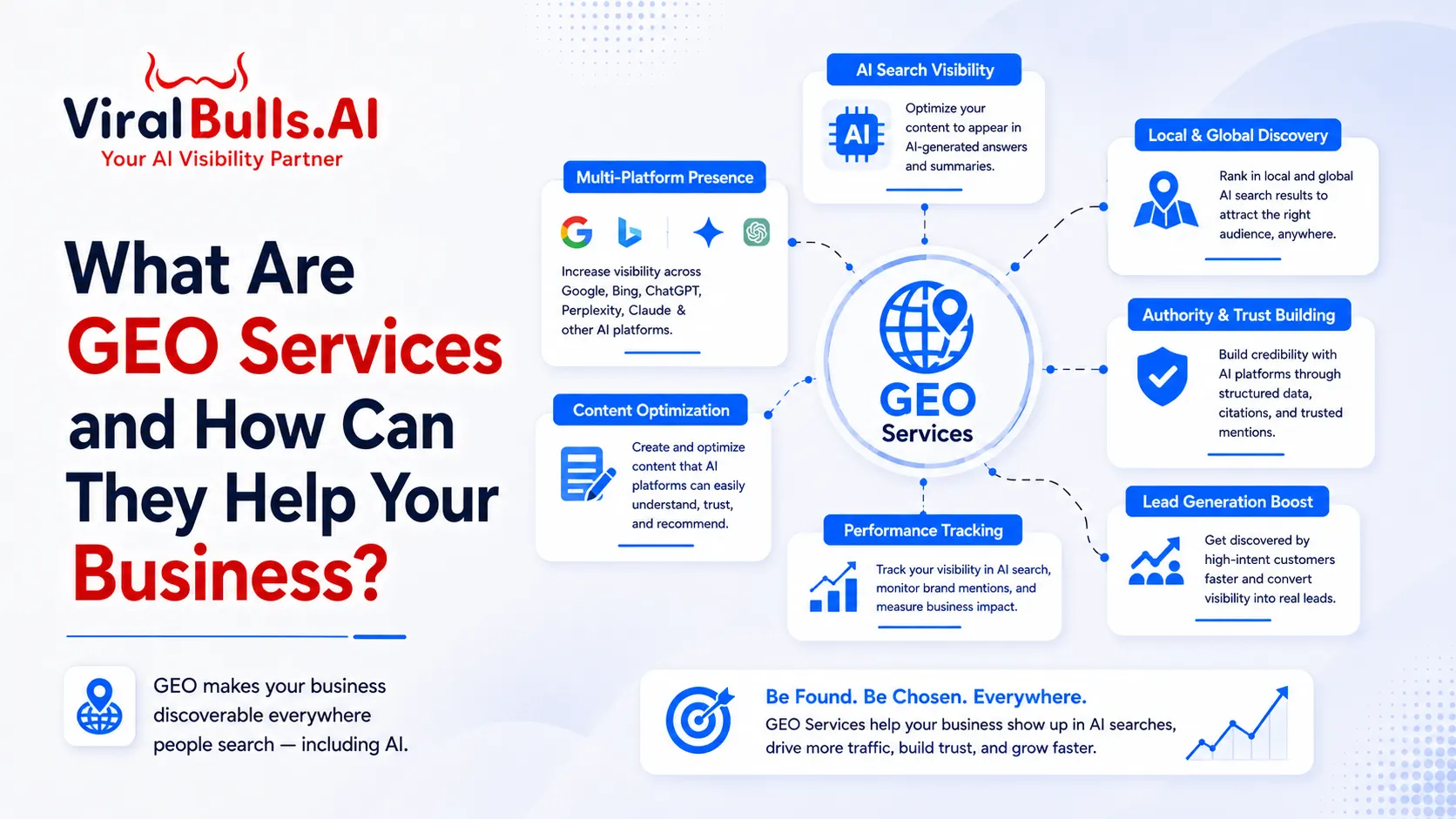
That is where GEO Services, or Generative Engine Optimization Services, enter the picture.
GEO is an emerging approach to digital visibility focused on helping brands become more understandable, authoritative, and discoverable within AI-powered search and answer experiences. The term gained broader attention following research published in 2023 that introduced Generative Engine Optimization as a framework for improving visibility within generative search environments.
As platforms such as ChatGPT, Gemini, Perplexity, Claude, Google AI Overviews, and other AI-driven discovery tools influence how people research businesses, products, and services, GEO is becoming an important extension of traditional SEO.
But what exactly do GEO services include, and how can they help your business?
Let’s understand.
What Is GEO?
GEO stands for Generative Engine Optimization.
It refers to the process of optimizing your brand’s digital presence and content so that generative AI systems can more easily understand, retrieve, interpret, and potentially reference your information when responding to relevant user questions.
Traditional search engines typically present users with a list of webpages.
Generative engines work differently.
They may analyze several sources and generate a direct, conversational response.
For example, instead of searching:
“best project management software for startups”
and manually opening several websites, someone might ask an AI assistant:
“What project management software would you recommend for a 15-person startup that needs task automation, client collaboration, and simple reporting?”
The AI system may then summarize multiple options.
For businesses, appearing within those recommendations can create a completely different type of visibility.
Google itself recognizes GEO as a term used for optimization focused on generative AI search experiences, although Google emphasizes that established SEO principles continue to be highly relevant to AI-powered search.
What Are GEO Services?
GEO services are strategies designed to strengthen a business’s presence across generative search and AI-assisted discovery.
They do not involve simply adding more keywords to a webpage.
A comprehensive GEO strategy may evaluate how clearly AI systems can understand:
- Who your company is
- What products or services you provide
- Which industries you serve
- What problems you solve
- What makes your business different
- Whether other credible sources mention your brand
- Whether your website demonstrates expertise
- Whether your content directly answers customer questions
- Whether important information is structured clearly
The objective is to create a strong digital footprint that gives AI systems clearer and more credible information about your brand.
How GEO Is Different From Traditional SEO
SEO and GEO are closely connected, but their primary visibility goals differ.
Traditional SEO generally focuses on ranking webpages within search engine results.
GEO focuses more specifically on whether information about your company can become part of AI-generated answers.
Traditional SEO Might Ask:
“How do we rank this page for ‘AI marketing agency’?”
GEO Might Ask:
“When somebody asks an AI platform to recommend an AI marketing agency for their needs, what information would help the platform understand why our business is relevant?”
That changes the optimization approach.
| Area | Traditional SEO | GEO |
|---|---|---|
| Main Goal | Rank webpages | Improve visibility in AI-generated answers |
| Search Experience | Search result listings | Conversational answers |
| Optimization Focus | Keywords, rankings, links | Entities, authority, context, citations |
| Content Strategy | Search query targeting | Detailed question and intent coverage |
| Authority | Backlinks and domain signals | Brand authority across multiple credible sources |
| Measurement | Rankings and traffic | Mentions, citations, visibility and answer presence |
| User Behaviour | Search and click | Ask, compare, refine and receive answers |
Importantly, businesses should not interpret this as GEO replacing SEO.
Google specifically advises businesses that foundational SEO practices remain relevant to its generative AI search features.
A strong GEO strategy therefore usually begins with strong SEO fundamentals.
What Do GEO Services Typically Include?
GEO is not one individual optimization technique.
It combines content, technical optimization, authority building, brand positioning, and ongoing analysis.
1. AI Visibility Analysis
Before improving visibility, businesses need to understand their current position.
A GEO audit may investigate questions such as:
- Does AI recognize the brand?
- How does AI describe the company?
- Which competitors are recommended?
- Which websites are being cited?
- Which customer questions trigger competitor mentions?
- Does the AI provide accurate information about the company?
- Are important services missing from AI-generated answers?
This creates a baseline for improving AI visibility.
Unlike a traditional keyword ranking, AI visibility should not necessarily be judged from one prompt or one test. Research published in 2026 highlights that AI-generated results can vary between prompts, runs, platforms, and time, making repeated measurement important.
2. Entity and Brand Optimization
AI systems need to understand exactly what a company represents.
If information about your organization is inconsistent across the web, identifying the relationship between your brand, services, expertise, and industry becomes more difficult.
GEO therefore involves strengthening your brand as a recognizable digital entity.
This may include improving:
- About pages
- Service descriptions
- Founder or expert profiles
- Organization information
- Industry positioning
- Product descriptions
- Business listings
- Structured data
- Consistency of brand information
Your website should clearly communicate the answers to questions such as:
Who are you?
What do you specialize in?
Who do you help?
Why should someone trust you?
Clarity matters.
3. Content Designed for AI Understanding
Generative search relies heavily on understanding context.
That means content should move beyond keyword repetition and provide genuine, structured information.
Effective GEO content may include:
- Clear definitions
- Frequently asked questions
- Step-by-step explanations
- Comparisons
- Examples
- Statistics
- Expert insights
- Case studies
- Pros and cons
- Original research
- Detailed service information
Research examining AI citation behavior suggests that content structure, semantic alignment, factual evidence, definitions, comparisons, and procedural information can be meaningful factors in how sources contribute to AI-generated answers.
Consider the difference between these two statements:
Weak:
“We provide the best AI marketing services for businesses.”
Stronger:
“Our AI marketing services help businesses analyze customer behaviour, automate marketing workflows, improve search visibility, personalize campaigns, and identify growth opportunities using AI-powered analysis.”
The second provides substantially more context.
AI systems have more information available to understand what the business actually does.
4. Conversational Query Optimization
People communicate differently with AI compared with conventional search engines.
Traditional search:
“CRM software small business”
Conversational AI search:
“What CRM should a small B2B company choose if it has a five-person sales team and needs automated follow-ups without expensive enterprise features?”
GEO therefore involves identifying detailed questions customers might ask at every stage of their buying journey.
For example:
Awareness
“What is AI SEO?”
Consideration
“Is AI SEO better than traditional SEO?”
Comparison
“Which type of SEO strategy should a small business use?”
Purchase
“Which AI marketing agency provides SEO and GEO services?”
Creating content around these natural-language queries improves topic coverage and gives AI systems useful contextual material.
5. Building Topical Authority
Publishing one blog about a topic rarely creates strong subject authority.
Businesses need interconnected content demonstrating depth.
Imagine a company wanting to establish authority around AI marketing.
Instead of publishing one article, it might develop content around:
- AI marketing
- AI SEO
- Generative Engine Optimization
- Answer Engine Optimization
- AI content marketing
- AI marketing automation
- AI lead generation
- AI customer analytics
- AI search visibility
- AI-powered personalization
These pages can then connect through intelligent internal linking.
The result is a stronger topical ecosystem rather than isolated articles competing independently.
6. Third-Party Brand Authority
Your website is not the only source AI systems can use when evaluating a brand.
Information from credible third-party sources may also influence how a company is represented.
Research into AI search has found meaningful differences in how generative systems source information and has highlighted the importance of authoritative third-party or earned-media sources in AI visibility strategies.
GEO may therefore incorporate:
- Digital PR
- Industry publications
- Guest articles
- Expert commentary
- Business directories
- Reviews
- Interviews
- Relevant media mentions
- Research citations
This is one reason GEO cannot simply be treated as an on-page content exercise.
Your broader digital reputation matters.
How Can GEO Services Help Your Business?
The value of GEO becomes clearer when viewed from the customer’s perspective.
Increase Visibility Beyond Traditional Search
Customers increasingly discover information through more than conventional search listings.
Optimizing exclusively for traditional results can therefore leave potential visibility opportunities unexplored.
GEO expands your strategy toward AI-assisted discovery.
Position Your Brand as an Authority
AI visibility depends heavily on clear expertise and credible information.
Creating authoritative resources around your industry can strengthen both GEO and traditional SEO.
Instead of publishing generic promotional content, businesses can develop resources that genuinely answer customer questions.
Over time, this builds a stronger knowledge footprint around the brand.
Reach Customers Earlier in Their Buying Journey
Many AI conversations begin before the customer has chosen a brand.
Someone may ask:
“What type of marketing strategy should a SaaS startup use?”
Then:
“Should we invest in SEO or paid advertising first?”
Then:
“Which agencies specialize in AI-driven organic marketing?”
A strong GEO strategy creates opportunities to become visible throughout this research journey rather than only when someone searches your company name.
Improve Content Quality
GEO encourages businesses to create clearer, deeper, more informative content.
That also benefits human visitors.
A page containing definitions, comparisons, examples, FAQs, evidence, and practical recommendations is generally more helpful than a page created primarily around keyword repetition.
GEO and user experience can therefore reinforce each other.
Strengthen Future Search Readiness
Search behavior continues to become more conversational and AI-assisted.
Businesses that build strong content architecture, brand authority, structured information, and machine-understandable digital assets today may be better prepared as AI discovery continues to develop.
Can GEO Guarantee That AI Will Recommend Your Brand?
No responsible GEO strategy should promise guaranteed recommendations.
Generative AI systems are probabilistic, and their outputs can vary depending on the model, prompt, retrieval process, available information, and timing. Recent research has emphasized that GEO visibility is more complex than a traditional fixed ranking and should be evaluated across repeated observations rather than a single result.
GEO should therefore be viewed as improving the conditions for visibility, not controlling AI answers.
Just as SEO cannot guarantee a permanent number-one Google ranking, GEO cannot guarantee that one brand will always appear in every AI response.
SEO + GEO: The Stronger Strategy
The strongest approach is not:
SEO vs GEO.
It is:
SEO + GEO.
SEO builds the technical and organic foundation.
GEO extends that foundation into generative discovery.
Businesses should continue focusing on:
- Technical website health
- Useful content
- Search intent
- Internal linking
- Backlinks
- User experience
- Website authority
While adding GEO-focused activities such as:
- AI visibility monitoring
- Conversational query research
- Entity optimization
- Brand consistency
- AI-friendly content structuring
- Third-party authority building
- Citation monitoring
- Detailed topical coverage
Together, these create a broader search visibility strategy.
How to Get Started With GEO
Businesses do not need to rebuild their entire marketing strategy overnight.
Start with a structured process.
Step 1: Audit Your Current AI Visibility
Test important commercial and informational questions related to your industry.
Understand which brands and sources frequently appear.
Step 2: Strengthen Your Existing SEO Foundation
Resolve crawlability, website architecture, content quality, internal linking, structured information, and other core SEO issues.
Step 3: Identify Customer Questions
Map the questions customers ask before, during, and after evaluating your services.
Step 4: Create Authoritative Content
Answer those questions with useful, factual, well-structured resources.
Step 5: Strengthen Brand Signals
Build consistent information and credible mentions across your wider digital ecosystem.
Step 6: Measure Continuously
Track AI mentions, citations, competitor visibility, search rankings, organic traffic, and conversions together.
The Future of Visibility Is Bigger Than Google Rankings
Search is evolving from finding links to receiving answers.
That changes what digital visibility means.
A business may have excellent search rankings but still have weak visibility when customers use AI tools to research solutions.
GEO helps address that gap.
It focuses on making your business easier for generative systems to discover, understand, contextualize, and potentially reference.
Traditional SEO still provides an essential foundation. GEO builds on that foundation for an increasingly AI-driven discovery environment.
For businesses, the objective should not be to chase every new marketing trend.
It should be to build a digital presence strong enough to remain visible regardless of how customers choose to search.
At Viralbulls AI, GEO can be approached as part of a broader AI visibility strategy that connects search optimization, authoritative content, brand positioning, and AI-driven discovery.
Because tomorrow’s customers may not always search for your business.
They may simply ask AI who they should choose.
And your brand needs to be part of the answer.