
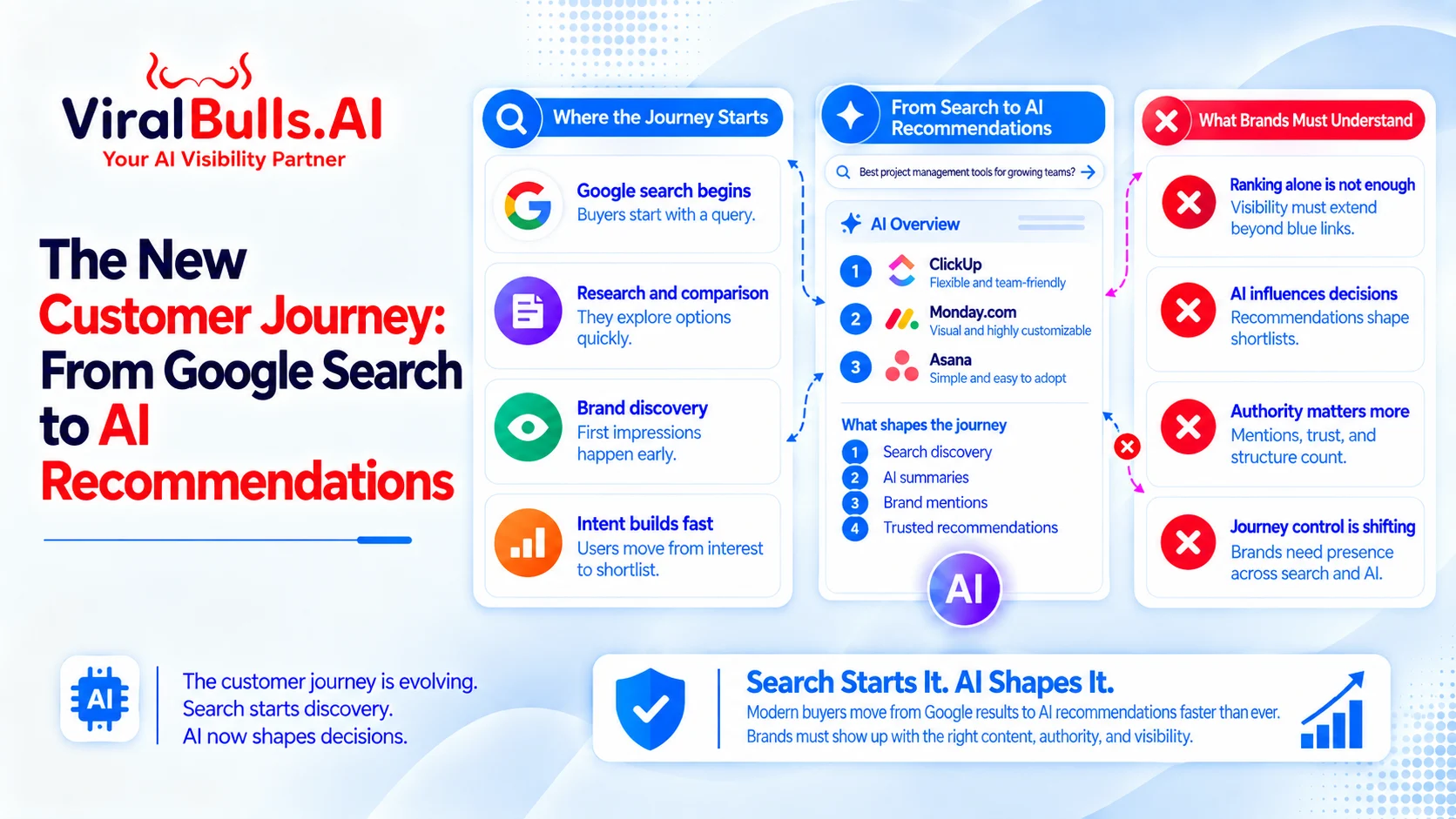
A customer asks Google for options, watches a creator explain the problem, asks an AI assistant to compare providers, reads reviews, and visits two websites before contacting anyone.
The journey is no longer a clean funnel from keyword to landing page to form submission. Search and recommendation systems increasingly summarize information and influence the shortlist before the first click.
Businesses need to optimize not only for traffic but for the information environment surrounding the decision.
Stage 1: Problem Discovery
Buyers begin with broad questions, symptoms, frustrations, or goals. Helpful educational content remains important because it creates the language through which the category is understood.
AI SEO services should map these questions and build connected content rather than isolated keyword pages.
Stage 2: Search and Exploration
Google Search remains central. Strong technical SEO, useful content, clear titles, internal links, and authority signals help pages become discoverable.
AI-powered search features may synthesize information from multiple sources, reducing the number of pages a buyer visits. Being understandable and credible matters alongside ranking position.
Stage 3: AI-Assisted Comparison
Buyers ask answer engines to compare options, explain trade-offs, recommend categories, or prepare a shortlist.
Generative Engine Optimization focuses on improving the clarity, evidence, entity signals, and external credibility that may help systems understand the brand.
No optimization can guarantee a recommendation. The objective is to make accurate information easier to retrieve and evaluate.
Stage 4: Trust Validation
After receiving recommendations, buyers often verify them through reviews, case studies, founder profiles, product pages, professional coverage, and customer discussions.
A brand with strong rankings but weak proof may lose at this stage. Consistent claims and transparent evidence are essential.
Stage 5: Website Conversion
The website must quickly confirm relevance. Service scope, use cases, process, pricing context, proof, and next steps should be easy to find.
A search-ready website that creates confusion wastes the authority earned earlier in the journey.
Stage 6: Human and Automated Follow-Up
The form submission is not the end. Fast routing, useful confirmation, contextual sales preparation, and appropriate nurture determine whether interest becomes a conversation.
AI can support qualification and summaries, while people handle judgment, trust, and negotiation.
What Businesses Need to Change
- Build topic authority across the full decision journey
- Publish first-party evidence and case experience
- Keep company and service information consistent
- Improve technical SEO and site usability
- Create content that answers comparison and implementation questions
- Strengthen reviews, mentions, and expert identity
- Connect website conversion to CRM and follow-up
How to Measure the New Journey
Traditional rank and traffic metrics remain useful but incomplete.
Track branded search, assisted conversions, qualified enquiries, engagement with proof pages, AI-feature visibility where reporting is available, sales-call themes, and the sources influencing customer decisions.
Ask new customers how they discovered and evaluated the brand. AI recommendations may influence the journey without producing a simple referral path.
How ViralBulls Connects SEO, GEO, and Conversion
ViralBulls builds search strategies around the complete customer journey. We combine technical SEO, content architecture, Generative Engine Optimization, authority development, website conversion, and marketing automation.
Our AI SEO services focus on becoming useful and credible across traditional search and AI-assisted discovery, then ensuring that visibility leads to a clear next step.
Final Thought: The Journey Is Becoming a Conversation
Customers are moving from typing short keywords to asking detailed questions and requesting recommendations.
Brands that publish clear knowledge, demonstrate credibility, and provide a strong conversion experience will be better positioned across both search and AI systems.
Old Journey vs New Journey
| Stage | Traditional Pattern | AI-Influenced Pattern |
| Discovery | Keyword search | Questions across search, social, and AI |
| Evaluation | Visit several ranking pages | Receive synthesized comparisons |
| Trust | Website claims and reviews | Cross-source entity and evidence validation |
| Conversion | Landing page form | Website plus contextual assistant and follow-up |
| Measurement | Last-click traffic | Multi-touch discovery and recommendation influence |
Content Must Serve Different Moments of Intent
Awareness content should explain the problem without forcing a sales decision. Comparison content should clarify trade-offs. Decision content should provide proof, implementation detail, and a clear next step.
When all pages repeat the same sales language, search systems have less useful information to work with and customers cannot progress confidently. A connected content architecture allows each page to perform a distinct role.
Example: How a Buyer Selects an AI Development Partner
A buyer may begin with Google to understand AI application costs, then ask an AI assistant which development approach suits a regulated business. The buyer checks two recommended companies, reads case studies, looks at leadership profiles, and asks a final question about security before booking a call.
A company can lose at any point: missing educational content, unclear industry relevance, weak evidence, or a slow follow-up. Search optimization must therefore connect discovery with trust and operations.
The Role of External Authority
A brand cannot define its reputation only through its own website. Reviews, genuine media coverage, partner references, directories, professional communities, and customer discussions influence how buyers and systems evaluate it.
Authority-building should focus on real relevance. Artificial mention campaigns, low-quality guest posts, and fabricated reviews may create temporary signals but undermine long-term trust.
Build for Continuity Across the Journey
The language used in ads, search pages, AI-ready content, sales materials, and customer conversations should be consistent. When every channel describes the service differently, the buyer has to reconcile the contradictions.
A modern search strategy therefore needs governance across marketing and sales, not only keyword research.
Search Strategy Must Include Post-Click Experience
A recommendation creates an expectation before the visitor arrives. If an AI answer describes the brand as suitable for a specific industry, the website should quickly confirm that relevance with matching services, evidence, and language.
Slow pages, generic navigation, hidden contact details, or inconsistent claims break continuity. The visitor may return to the answer and choose another provider.
Search and conversion teams should therefore review important journeys together. The page that earns visibility, the proof that builds trust, the form that captures intent, and the response that follows should feel like one experience rather than four separate systems.
How to Map the New Journey for Your Brand
Begin with real customer evidence. Review search queries, sales-call notes, chat logs, customer emails, lost-deal reasons, and questions asked during onboarding. Group these signals into discovery, comparison, validation, and decision stages.
Next, identify which source currently answers each question. Some answers belong on the website, while others need reviews, case studies, video, partner pages, or sales materials. Note where the information conflicts or disappears between channels.
Finally, assign metrics to each stage. Discovery may use impressions and branded demand. Evaluation may use engagement with comparisons and case studies. Decision should use qualified enquiries, sales progression, and revenue. This prevents the journey map from becoming a decorative diagram.
The Customer Journey Will Keep Changing
Search interfaces and AI assistants will evolve, but the underlying customer needs remain stable: understand the problem, compare credible options, reduce risk, and choose a next step.
Brands that organize reliable information around those needs will adapt more easily than brands built around one platform tactic.
Why Brand Memory Matters
A buyer may not convert during the first search session. The brand name, point of view, or useful framework may influence a later direct visit.
Consistent language and recognizable expertise help the company remain memorable across Google, AI answers, social content, and sales conversations. This is why brand and search strategy increasingly overlap.
Frequently Asked Questions
No. Search remains central, while AI-generated summaries and recommendations are becoming additional discovery layers.
It is the practice of improving content and brand signals for visibility in generative search and answer experiences.
Yes. Technical accessibility, useful content, authority, and user experience remain essential.
By publishing clear and credible information, building authority, earning genuine mentions, and maintaining consistent entity signals.
Some platforms and search tools provide partial reporting, but influence may also appear through branded searches and assisted conversions.
They may include audits, technical SEO, topic strategy, entity clarity, structured data, content, authority, GEO, and measurement.