
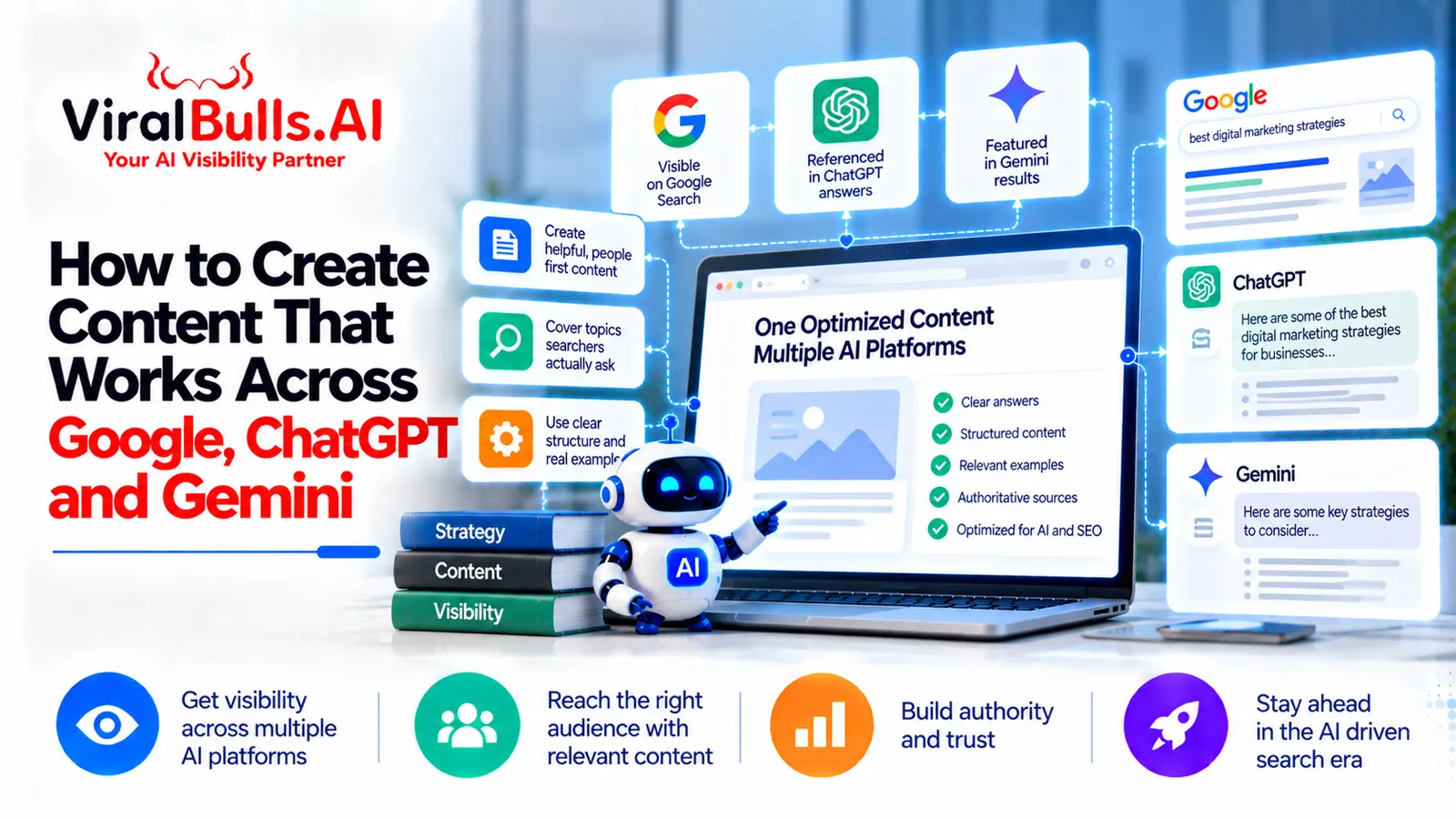
Picture this: you publish a blog post, it ranks on page one of Google within a few weeks, and traffic starts rolling in. Six months ago, that would have been the whole story. Today, it’s only half of it. Somewhere between your last coffee and your next one, a prospective customer asked ChatGPT “what’s the best salon software for small teams” or asked Gemini to “compare skincare brands for sensitive skin,” and neither of them ever touched a search results page. If your content wasn’t built to be understood, trusted, and quoted by AI systems, you weren’t even in the running.
This is the new reality of content marketing: you’re no longer writing for one audience and one algorithm. You’re writing for readers, for Google’s crawlers, and for large language models that summarize, synthesize, and recommend on your behalf. The good news is that the fundamentals of great content haven’t changed: clarity, expertise, and usefulness still win. What’s changed is how that content needs to be structured, verified, and distributed so all three systems can find it, trust it, and use it.
In this guide, we’ll break down exactly how to create content that performs on Google, gets cited by ChatGPT, and surfaces in Gemini’s AI Overviews without splitting your strategy into three disconnected efforts.
Why ‘Ranking’ No Longer Means Just Google
Search behavior has fractured. Traditional search engines are being joined — and in some use cases replaced — by conversational AI tools that answer questions directly instead of handing back a list of blue links. This shift has given rise to a new discipline sitting alongside SEO: Generative Engine Optimization, or GEO.
SEO and GEO aren’t rivals. They’re two lenses on the same goal: being the source that gets chosen when someone needs an answer. Google still rewards technical soundness, backlinks, and search intent matching. ChatGPT and Gemini reward content that is well-organized, factually reliable, and easy to extract and summarize. The businesses that win going forward are the ones that satisfy both sets of criteria at once.
The Common Ground: What All Three Platforms Actually Reward
Before diving into platform-specific tactics, it helps to understand the shared DNA of content that performs everywhere. Google, ChatGPT, and Gemini are all, at their core, trying to solve the same problem: serving the most trustworthy, relevant, and well-structured answer to a person’s question. Here’s what that means in practice.
1. Answer the Question First, Explain Second
Both search engines and AI models favor content that leads with the direct answer before expanding into detail. Bury your key point three paragraphs deep and you risk being skipped by an AI summarizer that’s scanning for the fastest path to a usable answer. Open each section with a clear, quotable statement, then support it with context, data, or examples.
2. Structure Is Not Optional
Headings, subheadings, bullet points, numbered steps, and short paragraphs aren’t just for readability anymore — they’re how AI models parse and extract information. Content that reads as one dense wall of text is far harder for a language model to break into a clean, citable snippet. Think of every H2 and H3 as a signpost that tells both humans and machines exactly what’s coming next.
3. Demonstrate Real Experience and Expertise
Google’s E-E-A-T framework Experience, Expertise, Authoritativeness, Trustworthiness has quietly become the same standard AI models use when deciding which sources to trust and cite. Generic, recycled content rarely gets surfaced by either. Original insights, first-hand case studies, specific numbers, and named expertise signal that a real, credible source is behind the words.
4. Be Factually Precise and Easy to Verify
AI models are cautious about citing sources that make vague or unverifiable claims. Back up statements with data, dates, and named examples wherever possible. Precision reads as trustworthiness — to a human reader and to a model deciding what to quote.
Platform-Specific Moves That Give You an Edge
For Google: Technical SEO Still Matters
Keyword research, on-page optimization, internal linking, page speed, and mobile usability remain foundational. Use tools to identify what your audience is actually searching for, then map that intent to a content plan that covers the full funnel: awareness, consideration, and decision. Structured data (schema markup) is especially important now, since it helps Google’s AI Overviews understand and lift content directly from your pages.
For ChatGPT: Be the Source Worth Citing
ChatGPT often draws on web browsing and training data shaped by what’s widely published, well-structured, and repeatedly referenced. To improve your odds of being surfaced, publish content on a consistent topic cluster so your brand becomes associated with a specific area of expertise. Use clear definitions, FAQs, and comparison formats, since these map neatly onto the conversational questions people actually type into chat interfaces.
For Gemini: Win the AI Overview
Since Gemini powers Google’s AI Overviews, content that already ranks well organically has a head start. Focus on concise, well-labeled answers near the top of the page, use bullet points for scannable facts, and keep your most important claims within the first 100 to 150 words of a section. Gemini tends to favor content that reads as neutral and informative rather than heavily promotional.
Building a Content Workflow That Serves All Three
Trying to write three separate versions of every piece of content isn’t sustainable. Instead, build a single workflow with these checkpoints baked in:
- Start with intent, not keywords. Understand the real question behind the search before you outline anything.
- Draft with a clear structure. Lead with the answer, follow with support, and use descriptive headings throughout.
- Add proof. Include data, examples, or named expertise wherever a claim is made.
- Mark it up. Apply schema where relevant so machines can parse your content accurately.
- Review for extractability. Ask: if an AI model pulled just one paragraph from this page, would it still make sense on its own?
- Publish consistently. Regular, topically-focused publishing builds the authority signal both search engines and AI models look for.
This is exactly the kind of workflow we build for clients at Viralbulls — content strategies that don’t treat SEO and GEO as separate line items, but as one integrated system designed to earn visibility wherever your audience is actually looking.
The Takeaway
The brands that will dominate visibility over the next few years won’t be the ones chasing algorithm updates. They’ll be the ones who understood early that Google, ChatGPT, and Gemini are all, fundamentally, rewarding the same thing: content that is clear, credible, well-structured, and genuinely useful. Build with that standard in mind, and you’re not optimizing for a platform; you’re optimizing for trust, which every platform is ultimately trying to measure.
Frequently Asked Questions
GEO, or Generative Engine Optimization, is the practice of structuring content so AI tools like ChatGPT and Gemini can understand, trust, and cite it. SEO focuses on ranking in traditional search results; GEO focuses on being selected and summarized by AI-generated answers. The two overlap heavily and are best treated as complementary parts of one strategy.
No. A single, well-structured, well-researched piece of content can perform across all three when it leads with clear answers, uses proper headings, and includes credible, verifiable detail. Separate versions are rarely necessary and often dilute your authority instead of building it.
Timelines vary, but many brands notice AI models beginning to reference their content within a few weeks to a couple of months of consistent, well-optimized publishing, particularly if the site already carries some domain authority. Google’s organic rankings can take longer, often three to six months, depending on competition.
Yes. Structured data helps search engines and AI systems accurately interpret the content, purpose, and key facts on a page, which increases the likelihood of being featured in AI Overviews or cited directly in a conversational response.
Writing content that’s vague, overly promotional, or thin on real evidence. AI models are built to prioritize trustworthy, specific, well-supported answers, and content that reads as filler rarely earns a citation, no matter how well it’s optimized technically.